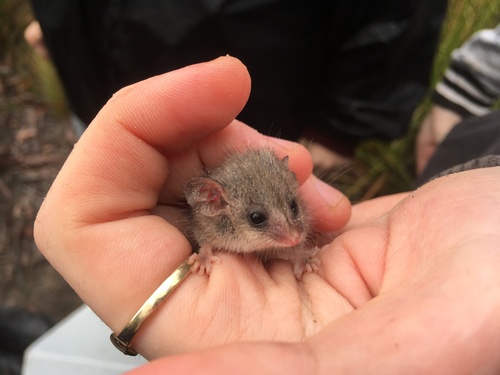
The smallest possum in the world, with a body barely larger than a mouse's. It was discovered by chance in 1888, when a naturalist realised that a museum specimen labelled as an Eastern Pygmy Possum was in fact a hitherto unknown species.
The smallest of all living diprotodonts, with a body of 50 to 65 mm and a tail of 60 to 75 mm; soft, pale fawn fur above and a grey belly, unlike other pygmy possums, which usually have a paler or white belly; conical head with a short snout, large eyes and short, rounded ears.
Although it has a prehensile tail and climbs easily, it lives close to the ground and avoids the high branches, probably to escape predation by nocturnal birds of prey. It shelters under logs, loose bark or dense vegetation.
Tall closed forest to low open forest and heath of south-eastern mainland Australia (from the heaths of Victoria to the forests of Tasmania), also present on Kangaroo Island.
Mainly palynivorous and nectarivorous; feeds on pollen and nectar, with a more varied diet in the wet heaths of Victoria, which favour continuous breeding throughout the year.
Although it can climb using its prehensile tail, it lives close to the ground, away from the high branches where it could be more vulnerable to predation by owls. Females have only four teats in the pouch, which limits litter size.
Widely distributed species considered Least Concern, with no sign of significant decline at global scale.
No major threats have been identified at global scale.
See all species accounts for kangaroos and koalas · Full species index
Mammaling is a free app for logging the mammals you find. You record a sighting in a moment — even if it's just a track — your life list grows, and the record becomes available to scientific and conservation projects.
It runs on your phone with nothing to install. If you like, it adds to your home screen like any other app.
Open Mammaling