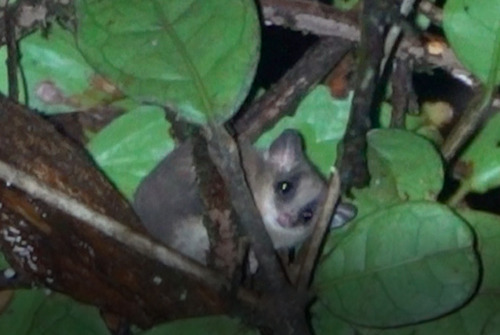
A small pygmy possum of the tropical montane rainforests of northern Australia and New Guinea, with a tail almost one and a half times as long as its own body. In the wild it can eat pollen as a protein substitute for the insects it eats in captivity.
Small, with a disproportionately long tail of 128 to 151 mm against a body of barely 106 mm; large eyes, mouse-like ears, a pouch that opens forwards and an opposable, clawless hind thumb adapted for climbing. As an adult it barely reaches 10 cm in body length.
Arboreal, it moves through the montane rainforest with the help of its long prehensile tail. It is thought to use its enlarged lower incisors to gnaw wood in search of insects, in a similar way to Leadbeater's Possum.
Montane rainforest above 300-1500 m altitude, in northern Australia and New Guinea, where it is known locally as “sumsum”.
Mainly insectivorous, although it can substitute pollen for insects to meet its protein needs; it also eats nectar.
Arboreal, with two litters a year of one to four young, born around January-February and sometimes a second in late August or early September; the young leave the nest at 45 days of age.
Widely distributed species within its montane rainforest habitat, with no sign of significant decline.
Loss of montane rainforest habitat, and climate change, to which species restricted to mountain areas are especially sensitive.
See all species accounts for kangaroos and koalas · Full species index
Mammaling is a free app for logging the mammals you find. You record a sighting in a moment — even if it's just a track — your life list grows, and the record becomes available to scientific and conservation projects.
It runs on your phone with nothing to install. If you like, it adds to your home screen like any other app.
Open Mammaling