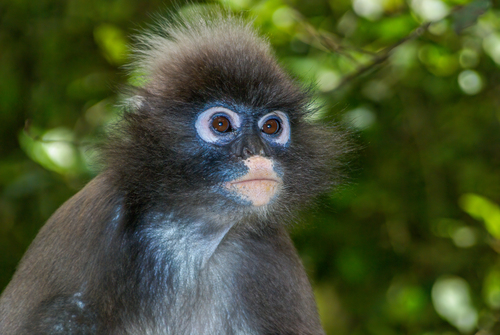
An Indochinese Gray Langur whose family tree turned out to be far more complex than expected: recent genetic analysis revealed that its origin dates back to an ancient hybridisation between two distinct langur lineages, an uncommon phenomenon documented in primates.
Slender-bodied with a long tail and the greyish pelage typical of the Indochinese grey langur group; unlike the Tenasserim Langur, from which it partly descends, it lacks such prominent large white eye rings.
Inhabits mainly the canopy of mature evergreen forest, unlike more terrestrial langurs of karst areas; nibbled leaf and fruit remains alongside group calls are the most common tracks and signs.
Mature evergreen forest of Indochina, from northern Thailand to Vietnam and west to eastern Myanmar, also present in southern China south of the Salween River.
Mainly folivorous, supplemented by fruit and seeds.
Lives in social groups, with a largely arboreal lifestyle in mature evergreen forest, unlike langurs of karst areas which are more terrestrial.
Total population estimated at only around 2400 to 2500 mature individuals, threatened by habitat destruction and, particularly in Vietnam and Laos, heavy hunting that has caused a very rapid decline.
Forest habitat destruction and heavy hunting, especially in Vietnam and Laos.
See all species accounts for primates · Full species index
Mammaling is a free app for logging the mammals you find. You record a sighting in a moment — even if it's just a track — your life list grows, and the record becomes available to scientific and conservation projects.
It runs on your phone with nothing to install. If you like, it adds to your home screen like any other app.
Open Mammaling