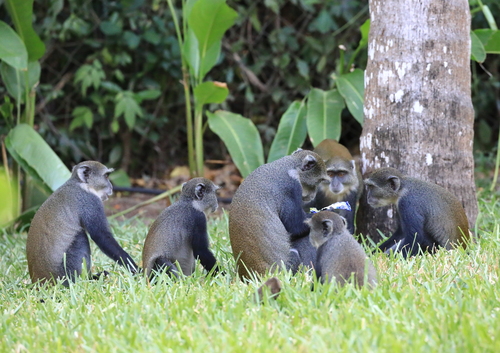
Inhabits the canopy of the forests of central and eastern Africa. There the males give a characteristic booming call that carries over long distances and keeps neighbouring troops apart without the need for direct encounters. It lives in stable groups built around bonds between related females, with a single resident male who usually changes every few years.
Bluish-grey to olive fur with a characteristic flecked tone, darker limbs and crown cap, and a pale patch on the throat that varies with the subspecies. It differs from other guenons in the combination of dark cap, bluish body tone and absence of conspicuous facial markings.
Tracks of hands and feet with opposable digits when it comes down to the ground to forage. Remains of discarded husks and fruit are usually left under fruiting trees. The males' booming call, deep and highly resonant, is the most diagnostic acoustic sign and carries clearly through the forest. Sleeping trees are recognised by their repeated use.
Primary and secondary forest, montane forest and riverine forest of central and eastern Africa, with populations also in southern Africa.
Mainly frugivorous, supplemented with leaves, flowers and invertebrates; forages above all in the middle and upper canopy.
Lives in troops of 10 to 40 females and young with a single resident adult male. Males give spaced booming calls to avoid direct encounters with rival groups. Females stay in their natal group for life, maintaining strong matrilineal bonds.
Remains stable and widely distributed over much of its range, although the populations of southern Africa are highly fragmented by forest loss and are at greater risk locally.
Deforestation and forest fragmentation, hunting for bushmeat in some areas, and genetic isolation of the southernmost populations.
See all species accounts for primates · Full species index
Mammaling is a free app for logging the mammals you find. You record a sighting in a moment — even if it's just a track — your life list grows, and the record becomes available to scientific and conservation projects.
It runs on your phone with nothing to install. If you like, it adds to your home screen like any other app.
Open Mammaling