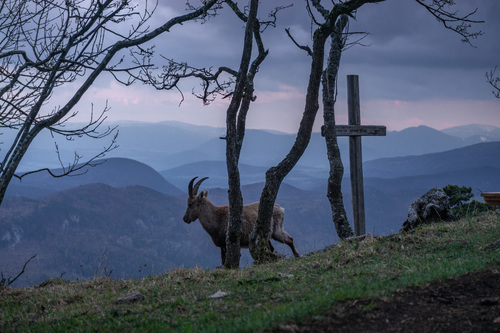
Few species have come so close to disappearing and returned so strongly. At the start of the 19th century about a hundred Alpine Ibex remained, all around the Gran Paradiso massif in north-western Italy. The last native Swiss Ibex was shot in the Valais in 1809. A royal decree of 1821 banned hunting it and, by the middle of the century, Victor Emmanuel II turned the area into a royal hunting reserve with its own wardens. The Gran Paradiso National Park was founded on that reserve in 1922.
The recovery in the rest of the Alps began with a smuggling operation. As the King of Italy refused to sell animals, in 1906 a zoological park in St Gallen bought from a poacher from the Aosta Valley two kids taken illegally out of the park, with the quiet approval of the Swiss federal authorities. Dozens more followed, and in 1911 the first release was made in the canton of St Gallen. Today there are about 55,000 Ibex in nearly 180 colonies, and practically all descend from that hundred in the Gran Paradiso.
The price of that history is in their genes. Of at least twelve maternal lineages that existed before the bottleneck only two survive, and their genetic diversity is among the lowest measured in wild mammals. Beyond genetics, the species has become famous for the females and kids that climb the almost vertical wall of the Cingino dam, in Piedmont, to lick the salts from the concrete.
Large, massive wild goat, with very marked sexual dimorphism. Males measure 149-171 cm in head and body length and up to about 100 cm at the withers, and weigh 65-120 kg, with the maximum in late autumn. Females measure 121-141 cm, with 70-84 cm at the withers, and weigh 40-60 kg.
The horns are the most conspicuous feature. In the male they form a great backward arc, scimitar-shaped and without a spiral, from 70 cm to almost a metre, with thick transverse knobs on the front face. In the female they are much shorter (18-35 cm), slender and smooth. They grow throughout life: in the male, about 7-9 cm a year until the age of 9 and less after. Age is read by counting the winter growth rings, not the knobs, several of which can form in a single year.
The coat is greyish brown, paler and shorter in summer and thicker and darker in winter; females are paler, tending to beige. Males carry a short beard. They have no facial mask.
What it is confused with:
• Alpine Chamois. It is more slender and has black, thin, hooked horns in both sexes (about 20-25 cm), and a white face with a black band through the eye. A female Ibex at a distance may recall it, but lacks that mask.
• Domestic goat and hybrids. Hybrids are usually larger and heavier than the Ibex, with longer horns, triangular in section, with flattened knobs or none, and unusual colours (dark, orange, with markings on the legs). There is no typical look, and some even lack horns. Moreover, animals shot in Switzerland as “suspected hybrids” turned out to be pure Ibex. It cannot be determined with certainty by appearance.
• Iberian Ibex (Capra pyrenaica). Its horns spread outwards and upwards and then turn inwards, lyre-shaped. Their ranges do not touch.
• Mouflon. It is a sheep, with spirally coiled horns in the male.
Track: larger and more rounded than the Chamois's, about 7-10 cm long by 6 cm wide, with blunt front edges and the two toes closer together. The hoof combines a hard outer rim with a soft pad that grips the rock, and the dewclaws do not register at a calm walk. At a walk, the stride measures 60-120 cm. It copes less well than the Chamois in soft snow and on ice, and in winters of heavy snow it concentrates on wind-swept slopes, which are where fewer tracks remain.
How to tell the track from those of other ungulates sharing the mountain:
• Chamois. About 6 × 3.5-5 cm, narrower and more elongated, with thin, pointed toes that spread widely.
• Red Deer. About 8-9 × 6-7 cm in the stag and smaller in the hind. It overlaps in size with the Ibex, but is more heart-shaped; at high elevation, habitat helps.
• Roe Deer. About 4-4.5 × 3 cm.
• Mouflon, sheep and domestic goat. There are no reliable comparative measurements, and where goats graze the track alone is not enough.
Droppings: no published measurements specific to the Alpine Ibex have been found. As a reference, those of the Iberian Ibex measure 1-2 × 0.6-1.1 cm, are cylindrical, with one end pointed and the other concave, and black and shiny when fresh. They can resemble those of Red Deer. Those of sheep and Mouflon are clearly more spherical. Those of the Chamois are smaller (0.8-1 cm) and in summer stick together in clusters. In practice, the pellets of Ibex, Chamois and domestic goat cannot be separated with certainty without other signs.
Sounds: a short, sharp alarm whistle, bleats of females and kids and, above all, the clash of the males' horns as they size each other up, which can be heard from far away in a quiet valley.
Other signs: it shelters at night in caves, crevices and rock shelters, where droppings and hair accumulate. It seeks salt insistently and licks rocks, walls and any surface with mineral efflorescences; the Cingino dam is only the extreme example.
When to look: in spring they come down to the meadows that green up on the valley floors, sometimes below the treeline, and it is the best time to see them and find fresh signs. In the early morning they sun themselves on east- and south-facing rock outcrops.
A high-mountain animal that lives mainly between 1,600 and 3,300 m, in steep rock outcrops alternating with alpine pastures, and that changes altitude with the seasons. In winter it concentrates on very steep, sunny, south-facing slopes, where the wind sweeps the snow away and leaves the grass exposed. In spring it comes down to the meadows that green up earliest, sometimes below the treeline, and in summer it climbs again, to 2,700-3,300 m, because it has no sweat glands and tolerates heat poorly. Females choose steeper, rockier terrain than males, which frequent flatter pastures. In the last quarter of a century, Ibex in the central Alps have shifted appreciably towards higher elevations.
It is exclusive to the Alps, and all its populations except that of the Gran Paradiso come from reintroductions, most founded between 1950 and 2000. In 2015 there were estimated to be about 19,900 Ibex in Italy, spread over 67 colonies; 17,700 in Switzerland, in 45; 8,800 in Austria, in 27; 7,800 in France, in 30; about 550 in Germany, in 5; and about 320 in Slovenia, in 4. They are also present in Liechtenstein. In Slovenia it is debated whether the species is native or was introduced in the late 19th century.
Colonies vary greatly in size. In the Valais about 7,000 animals were counted in 2025 and in the Grisons more than 7,000, while in the Dolomites there are about 700 spread over five colonies. In the last decade, the occupied area has barely expanded.
It is mainly a grass grazer. In the Swiss National Park, analysis of its droppings gave 70% grasses and sedges as an annual average, with clear changes through the year. In spring sedges reach a fifth of the diet, and in summer flowering herbs rise to 22%. In autumn grasses are almost three quarters of what it eats and dwarf shrubs, such as heathers and bilberries, are around 11%, and in winter conifers also come in, at around 8%. Stomach-content analyses give grasses even more weight, between 85 and 94%.
It prefers fescues, meadow-grasses, moor-grasses, bents and timothy-grasses, and also eats lichens, juniper shoots and thistles. According to the Vanoise National Park, in summer it takes in 15-20 kg of fresh vegetation a day, and dew may be enough to cover its water needs. In heat waves, large males feed at night. It needs mineral salts, which it seeks by licking rocks and structures.
Its diet overlaps with that of the Chamois for a good part of the year, but studies find no strong competition between the two.
It is active by day, with peaks early in the morning and in the late afternoon. It spends the night in rock outcrops, crevices or caves, and warms itself in the sun in the morning.
Males and females live apart for most of the year and join only for the rut, which lasts about six weeks between December and January; in April and May they separate again. Females form groups of 5 to 20 with their young, and males go in groups of 2 to 16, sometimes more than 50, with a hierarchy based on size, age and horn length. Epidemics upset that structure: on the Marmolada, after an outbreak of mange, the mean size of male groups fell from 27 to 7 and the proportion of solitary males rose from 17 to 46%.
Females in the Gran Paradiso use annual home ranges of about 180-190 ha, which shrink when there is a lot of snow and as they age. In reintroduced populations the ranges are considerably larger, up to about 3,000 ha, and adult males stay very faithful to their area from one year to the next.
Gestation lasts 165-170 days. Females give birth alone on rocky slopes, between late May and July, almost always a single young; twins are rare. Within a few days the kids already follow their mother and form nursery groups, and they suckle until about five months. Females usually give birth for the first time at 3-4 years and do not breed every year: in one study, 84% of those aged four or more were pregnant, but in June only a third of adults in their prime were accompanied by a kid. Males keep growing until 9-11 years, and breeding is monopolised by the older ones.
In the Gran Paradiso, up to three quarters of kids die in the first year. Adults die of old age, starvation, disease and avalanches. The Golden Eagle and the Red Fox take kids, but the steep terrain protects adults from the Wolf: in the Gran Paradiso, since its return, the Wolf feeds mainly on Chamois and Roe Deer.
The species is stable today. It has gone from about 47,000 animals around 2005-2007 to about 55,000 in 2015, with increases in Switzerland and Italy and stability in France; in Austria, Germany and Slovenia the data are not sufficient to know the trend. Since the 1960s, the Italian and Swiss populations grew at a rate of 3-6% a year thanks to strict protection of the original core, to captive breeding in Switzerland from the smuggled animals and to a century of translocations of wild animals between colonies, from 1911 to 2014. The Gran Paradiso itself, however, has gone from about 5,000 Ibex in 1993 to about 2,600 in 2014, and in 2026 stands at around 2,700, a decline linked to lower kid survival.
Management varies from one country to another. Switzerland has allowed regulated hunting since 1977, around a thousand animals a year, and since 2023 each colony needs prior approval from the federal administration and at least half of those shot must be females. Austria also hunts it, whereas in Italy it is protected and an attempt to declare it a game species was withdrawn in May 2026. To avoid narrowing its genetic base further, geneticists recommend founding new colonies with animals from the source population or from several different populations, and not from a single derived colony.
Its greatest problem is the legacy of the bottleneck, a very low genetic diversity with heavy inbreeding. In 26 Swiss populations, inbreeding reduced population growth by up to 71%, and the effect is greater in wet summers.
Diseases come next. Sarcoptic mange has caused mortality of over 60% in the Dolomites and of up to 80% in Friuli, and on the Marmolada the colony fell from 456 animals to 208 in two years. In the Bargy massif, in Haute-Savoie, an outbreak of brucellosis passed in 2012 to cattle and to three people who had eaten raw-milk cheese. In 2013 alone 263 Ibex were culled, and the colony fell from about 570 animals to about 270; it is now back to about 375. The infection reached the neighbouring Aravis massif in 2022, and the courts halted the mass culls that followed. Infectious keratoconjunctivitis can also kill up to 30% of affected animals.
Climate change also takes its toll: a spring that greens up faster reduces kid survival, and heat pushes the species to higher elevations, where there is less habitat. Hybridisation with domestic goats is a localised but real problem, with 48 probable hybrids between 2000 and 2021 in 21 colonies, almost all in Italy; in Switzerland a hybrid group of 18 animals had to be removed between 1998 and 2001. Human disturbance and poaching are often cited, but there are no data that allow their weight to be measured.
See all species accounts for even-toed ungulates · Full species index
Mammaling is a free app for logging the mammals you find. You record a sighting in a moment — even if it's just a track — your life list grows, and the record becomes available to scientific and conservation projects.
It runs on your phone with nothing to install. If you like, it adds to your home screen like any other app.
Open Mammaling