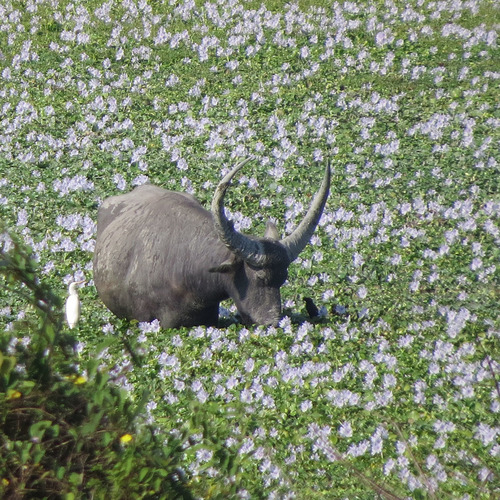
Almost certainly the wild ancestor of the domestic water buffalo seen on farms across half the world, but its truly wild form survives today in populations so small and fragmented that they barely total a few thousand individuals.
Large and robust, with a broad head, narrow convex forehead, large flattened horns curved laterally backwards — the longest among wild bovids —, funnel-shaped ears, a small dewlap and a slender tail. It differs from the domestic buffalo, with which it can hybridise, in its larger size and longer horns.
Very large cloven-hoofed tracks and signs near waterlogged areas; extensive mud wallows where it cools off and protects itself from insects; wide trails between damp grasslands and watercourses.
Wetlands, grasslands and riparian forest of the Indian subcontinent and South-east Asia, always tied to the presence of water.
Herbivorous; grazes tall grasses as well as aquatic and semi-aquatic vegetation.
Lives in herds near wetlands and watercourses, wallowing frequently in mud; heavily dependent on water to thermoregulate and avoid insects.
Total population under 4000 mature individuals, classified as Endangered since 1986, with a projected decline of at least 50% over the last three generations that is expected to continue.
Genetic hybridisation with domestic buffalo, wetland habitat loss, poaching and disease transmission from livestock.
See all species accounts for even-toed ungulates · Full species index
Mammaling is a free app for logging the mammals you find. You record a sighting in a moment — even if it's just a track — your life list grows, and the record becomes available to scientific and conservation projects.
It runs on your phone with nothing to install. If you like, it adds to your home screen like any other app.
Open Mammaling