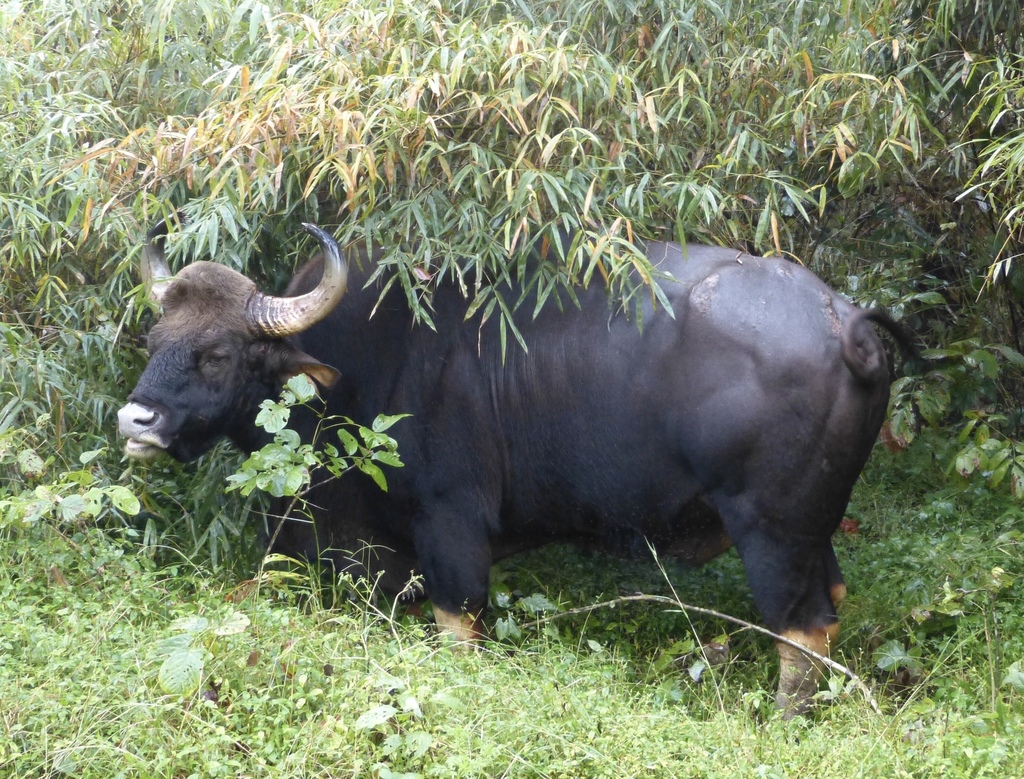
The largest wild bovid in the world, a muscular giant of Asia with a prominent dorsal ridge over the shoulders and a generally calm temperament despite its imposing size, which lives in herds led by females.
Enormous and massive, with a prominent muscular ridge over the shoulders that gives it a characteristic silhouette, a short, dark coat (brown to almost black in adults) with distinctive white “stockings” on the legs, and robust, upward-curving horns present in both sexes. It is the largest living wild bovid, clearly bigger than the Wild Water Buffalo.
Very large, broad cloven-hoof tracks; heavily used, broad paths between grazing areas and water; bulky droppings in the form of pats; trees with bark scraped by the rubbing of horns.
Tropical and subtropical forest, wooded hills and adjacent grassland, from India and Nepal to mainland South-east Asia and the Malay Peninsula.
Herbivorous; grazes grasses and browses leaves, shoots and fruit.
Lives in mixed herds led by a female, with adult males often solitary or in small bachelor groups. Active mainly by day, although it can become more nocturnal near human-inhabited areas.
Population estimated at a maximum of 21,000 mature individuals, with most in India; declining through hunting and habitat loss across much of its range.
Poaching for its meat and trophies, habitat loss through agricultural expansion, and risk of disease transmission from domestic livestock.
See all species accounts for even-toed ungulates · Full species index
Mammaling is a free app for logging the mammals you find. You record a sighting in a moment — even if it's just a track — your life list grows, and the record becomes available to scientific and conservation projects.
It runs on your phone with nothing to install. If you like, it adds to your home screen like any other app.
Open Mammaling