In March 1927, during the Field Museum of Chicago's expedition to Abyssinia, Wilfred Osgood set a trap in a stream at the headwaters of the Little Abbai, south of Lake Tana, at about 2,600 metres, and caught a black, broad-footed rat that smelled of fish. It is the only specimen in existence. In 2012 and 2018 a team trapped in the Choke mountains without finding it; according to summaries of that work, when it reached the place where it had been caught, on horseback, the stream was degraded or gone.
It is considered the most water-adapted of African rodents: soft fur, slate-black above and white below, tiny eyes and ears, long whiskers and even sensory hairs on the wrists, and broad, fringed hind feet for swimming. About fifteen centimetres of body and a longer tail. It also has a strange skull, with a large braincase. It is the only member of its genus, and one of the rarest genera of mammals in the world.
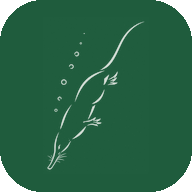
No scientist has seen it alive. What little is known comes from the specimen and from its collector's notes: it lived in mountain streams, and its stomach contents smelled of fish, which suggests it ate small fish. The drawing on this card is the one that accompanied the original description. For decades it was treated as a subspecies of a Congo water rat, until in 1995 it was shown to be a genus of its own; in 2020 its closest relative turned out to be that very water rat.
Wilfred Osgood caught it in March 1927, during the Field Museum of Chicago and Chicago Daily News expedition to Abyssinia: an adult male, in a stream feeding the Little Abbai near its source, south of Lake Tana, at about 2,600 metres. Osgood described it in 1928, and the skin and skull are still in Chicago. Even then the habitat was degraded, and today the area is mostly pasture, heavily trampled by cattle.
It has been searched for at least twice without success. In 2012 and 2018 a team worked in the Choke mountains, to the east, and caught 195 rodents of nine species, none of them this one. According to summaries of that work, in 2018 they reached the type locality on horseback and found the stream degraded or gone. The IUCN assessed it in 2021 as Critically Endangered, possibly extinct. Its only hope lies in the mountain streams of Gojjam and Choke that nobody has trapped yet.
Mammaling is a free app for recording the mammals you see. If anyone ever sees this animal again, it will be someone who was looking.
Open Mammaling