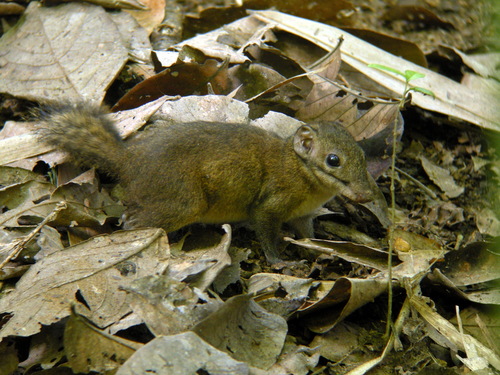
A South-East Asian squirrel that has almost completely given up nuts: its elongated snout and long, protractile tongue are adapted primarily for catching insects and earthworms, a highly unusual trait among squirrels.
Elongated body, 18.5 to 24.2 cm long plus a short, bushy tail of 9.5 to 15 cm that is usually held erect; strikingly elongated snout, much longer than that of any other squirrel in its range, with tiny, barely functional upper incisors; fur on the head and back reddish-brown to greyish-olive, flanks and belly white or pale yellow.
Solitary and rare, very seldom seen or recorded; feeds by rooting in the leaf litter for insects and earthworms, leaving small scrapes in the forest soil rather than obvious tracks and signs.
Forest of the Thai-Malay Peninsula, Sumatra and Borneo.
Mainly insectivorous for a squirrel, with earthworms and insects forming the basis of its diet, supplemented with fruit.
Solitary and very rarely observed; holds food with its front feet while eating, an unusual behaviour reported in captivity.
Considered Near Threatened due to the ongoing decline of its forest habitat.
Deforestation and loss of forest habitat.
See all species accounts for rodents · Full species index
Mammaling is a free app for logging the mammals you find. You record a sighting in a moment — even if it's just a track — your life list grows, and the record becomes available to scientific and conservation projects.
It runs on your phone with nothing to install. If you like, it adds to your home screen like any other app.
Open Mammaling