A form of striped grass rat peculiar to the forest margin of south-eastern South Africa, treated by most specialists as a subspecies of the Mesic Four-striped Grass Rat (Rhabdomys dilectus) rather than a fully independent species, although some authors favour separating it.
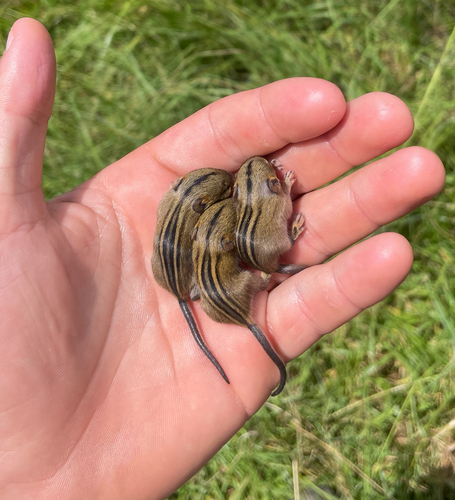
A small rodent with the genus's characteristic four dark longitudinal stripes against a brown background; indistinguishable to the naked eye from other forms of Rhabdomys, its recognition as a distinct genetic unit relies on molecular markers (mitochondrial DNA) rather than visible features.
Like other striped grass rats, the KwaZulu Natal Four-striped Grass Rat leaves small burrows and surface runways in forest-edge areas with good grass cover; no specific field data exist to distinguish this particular form.
Forest margins in Eastern Cape and southern KwaZulu-Natal, South Africa, possibly extending into southern Mozambique and Eswatini.
Omnivorous; seeds, vegetation and insects, like other striped grass rats.
A pioneer species that colonises forest clearings after deforestation; it depends on good grass cover, so overgrazing can cause local declines.
As it is mostly treated as a subspecies of Rhabdomys dilectus, it has no separate, independent assessment on the IUCN Red List.
Overgrazing that reduces the herbaceous cover on which it depends can cause local declines, though no impact on the overall population of the complex is expected.
See all species accounts for rodents · Full species index
Mammaling is a free app for logging the mammals you find. You record a sighting in a moment — even if it's just a track — your life list grows, and the record becomes available to scientific and conservation projects.
It runs on your phone with nothing to install. If you like, it adds to your home screen like any other app.
Open Mammaling