A population of pocket mouse from southern Sonora that most current mammalogists treat as a subspecies of the Southern Sinaloan Pocket Mouse, with a somewhat longer snout than the nominate form, rather than as a fully independent species. It lives in tropical dry forest and arid scrub in a specific strip of north-western Mexico, in the Mayo River basin, from where the first specimen was described in the late 19th century. Like the other pocket mice, it carries seed in external fur-lined pouches and never needs to drink liquid water at any point in its life. Its taxonomic status, halfway between subspecies and species depending on the author consulted, is one more example of how unsettled the classification of the small rodents of north-western Mexico remains.
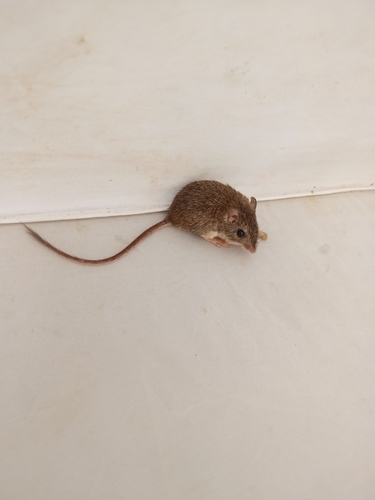
Small rodent, reddish-brown fur, a snout somewhat longer than that of the typical form of the Southern Sinaloan Pocket Mouse, with which many authors group it as a subspecies, a body covered in stiff hairs on the back, and a long tail with a terminal tuft. Field identification against that typical form requires capture and cranial comparison.
Small track with elongated hind feet (1.5-2 cm), similar to that of other pocket mouse species in the region. Small, elongated droppings 4-6 mm long, left scattered near the burrow.
Tropical dry forest and arid scrub, tied to the Mayo River basin. Distributed over a strip of north-western Mexico, in southern Sonora.
Granivorous, it feeds mainly on seed, supplemented with succulent vegetation and the occasional insect.
Solitary and strictly nocturnal, it stays in its burrow during the hot daytime hours.
Since most current classifications treat it as a subspecies within a widely distributed species with stable populations, it has no separate conservation assessment of its own.
Habitat loss through agricultural and ranching expansion in its range in southern Sonora.
See all species accounts for rodents · Full species index
Mammaling is a free app for logging the mammals you find. You record a sighting in a moment — even if it's just a track — your life list grows, and the record becomes available to scientific and conservation projects.
It runs on your phone with nothing to install. If you like, it adds to your home screen like any other app.
Open Mammaling