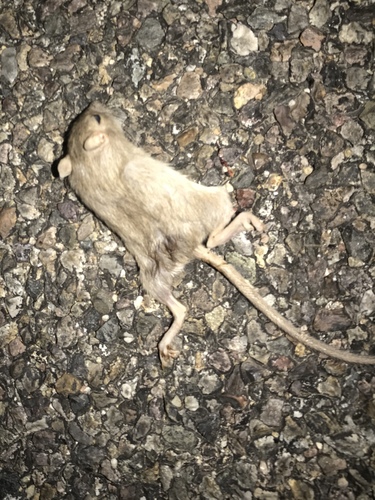
One of the most easterly-distributed pocket mice, and with the coarsest fur of its whole genus, able to live in tallgrass prairie and cultivated areas on the edges of the great North American desert, much further east than where most of its relatives are usually found. Its fur, markedly stiffer and more bristly than that of related species, gives it its common name in both Spanish and English. It lives in a very wide band running from the central United States to central Mexico, and like the other pocket mice it carries seed in external fur-lined pouches on either side of the mouth.
Relatively large rodent for a pocket mouse, with markedly stiff, bristly yellowish-brown fur and a strongly contrasting white belly, and a long tail with a terminal tuft. It differs from other pocket mice in its range in that especially coarse fur and in the sharp contrast between back and belly.
Track with elongated hind feet (1.8-2.2 cm), with the paired hopping marks typical of bipedal rodents. Small, elongated droppings 5-7 mm long, left scattered near the burrow. Digs simple burrows in loose prairie soil or at the edge of crops.
Tallgrass prairie, arid scrub and crop edges, from lowlands to mid elevations. Distributed from the central United States to central Mexico.
Granivorous, it feeds mainly on seed, supplemented with insects and occasional green vegetation.
Solitary and strictly nocturnal, it stays in its burrow during the hot daytime hours.
Its populations are considered stable over most of its wide range.
Faces no significant threats at species level; locally it suffers habitat loss through intensive agricultural conversion.
See all species accounts for rodents · Full species index
Mammaling is a free app for logging the mammals you find. You record a sighting in a moment — even if it's just a track — your life list grows, and the record becomes available to scientific and conservation projects.
It runs on your phone with nothing to install. If you like, it adds to your home screen like any other app.
Open Mammaling