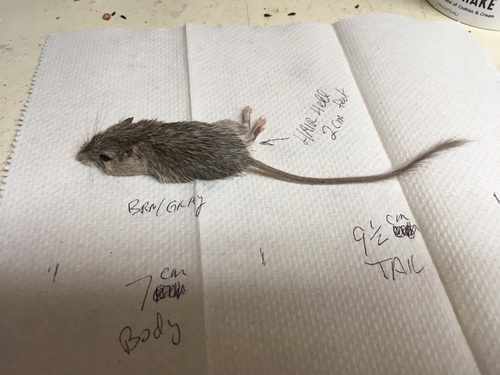
Lives in a very specific corner of south-western North America: the coastal scrub and chaparral of the far south of California and the north of Baja California. Urban expansion has intensely transformed this habitat, in one of the most densely populated regions of the western United States. Like the other pocket mice, it never needs to drink liquid water at any point in its life, obtaining all it requires from the metabolism of the dry seeds that make up the basis of its diet. It spends the day sheltered in a burrow dug beneath dense scrub and goes out to forage only at night, carrying the collected seed in external fur-lined pouches on either side of the mouth. Habitat fragmentation is so intense over much of its range that several isolated populations are the subject of specific conservation programmes, even though the species as a whole is not threatened.
Small rodent, greyish-brown fur with a whitish belly, a body covered in stiff hairs on the back, and a long tail with a terminal tuft, longer than the body. It differs from other pocket mice in its range in cranial details and in its distribution restricted to coastal scrub areas of the far south-west of North America.
Small track with elongated hind feet (1.5-2 cm), with the paired hopping marks typical of bipedal rodents. Small, elongated droppings 4-6 mm long, left scattered near the burrow. Digs simple burrows in loose soil under dense scrub, with the entrance often plugged during the day.
Coastal scrub and chaparral, from lowlands to mid-mountain elevations. Distributed across the far south of California, United States, and the north of Baja California, Mexico.
Granivorous, it feeds mainly on seed, supplemented with succulent vegetation and the occasional insect.
Solitary and strictly nocturnal, it stays in its burrow during the hot daytime hours.
Its populations are generally considered stable at species level, although several local populations are isolated and fragmented by urban expansion in southern California.
Loss and fragmentation of native coastal scrub through urban expansion in southern California.
See all species accounts for rodents · Full species index
Mammaling is a free app for logging the mammals you find. You record a sighting in a moment — even if it's just a track — your life list grows, and the record becomes available to scientific and conservation projects.
It runs on your phone with nothing to install. If you like, it adds to your home screen like any other app.
Open Mammaling