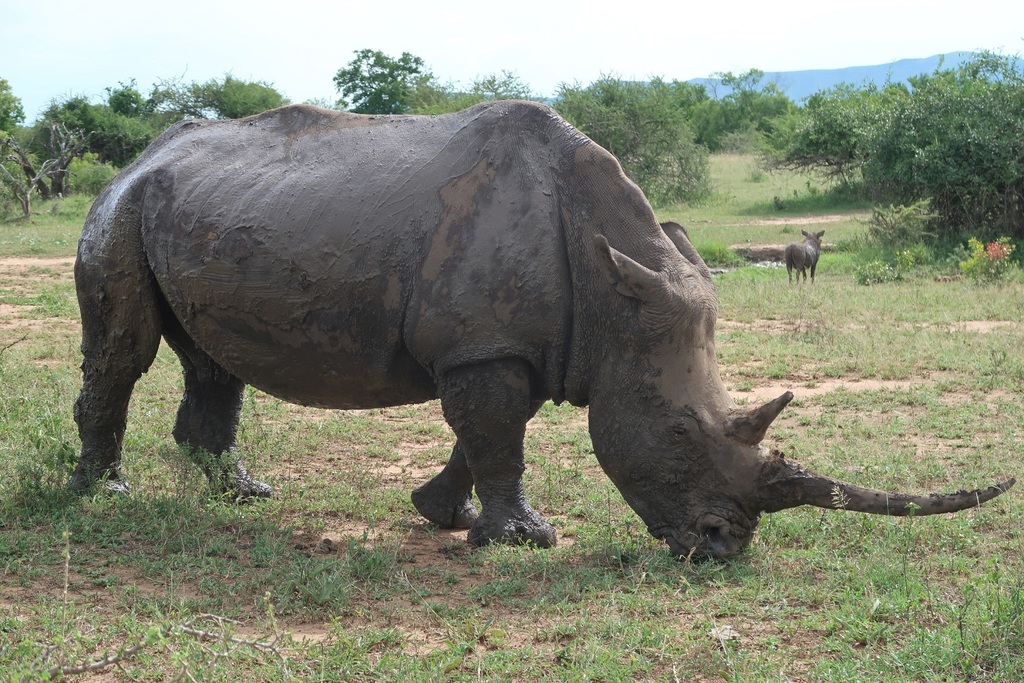
Its broad, square lip, adapted for tearing up short grass almost at ground level, is what gives it its name in English and Afrikaans: “wyd”, meaning wide, which ended up distorted into “white”. It has nothing to do with skin colour, which is practically the same grey as that of the Black Rhinoceros. It is the most social of the rhinoceroses and the subject of one of the best-documented conservation stories on the continent. The southern subspecies recovered from barely a handful of individuals at the start of the 20th century to become the most numerous in the world, while the northern subspecies has been reduced to just two females, with no fertile male to accompany them.
The second largest land mammal in the world, 3.4-4.2 m long and weighing 1.5-2.3 t, with two horns (the front one longer), a pronounced hump on the shoulders and, above all, a broad, square upper lip adapted for grazing. It differs from the Black Rhinoceros in that square lip (against the pointed, prehensile lip of the black), in its larger size and in carrying its head lower and forward.
Front track up to 30 cm wide (measured between the tips of the claws) and hind track about 25 cm, with 3 rounded toes and a heel mark forming an elongated “W”. It differs from the track of the Black Rhinoceros, which is smaller (23 cm front, 20 cm hind) and has a rounder heel and smaller outer toes set apart from the central one. It leaves large dung heaps shared by several individuals as a territorial signal, often scattered by kicking after defecating.
Grassland savannah, mainly in southern Africa (South Africa, Namibia, Zimbabwe, with reintroductions in Kenya); the northern subspecies survives only under intensive management, practically extinct in the wild.
Almost exclusive grazer of short grasses, which it tears up with its broad, flat lip.
More social than the Black Rhinoceros: females and young form small groups, while adult males are territorial and mark their territory with dung heaps and sprays of urine.
The southern subspecies recovered from barely a hundred animals at the start of the 20th century to some 16,000 individuals, although it has declined again through poaching over the last decade (15% between 2012 and 2017). The northern subspecies is functionally extinct, with only two surviving females and no breeding male.
Poaching for the horn, in high demand in some Asian markets, and habitat loss.
See all species accounts for odd-toed ungulates · Full species index
Mammaling is a free app for logging the mammals you find. You record a sighting in a moment — even if it's just a track — your life list grows, and the record becomes available to scientific and conservation projects.
It runs on your phone with nothing to install. If you like, it adds to your home screen like any other app.
Open Mammaling