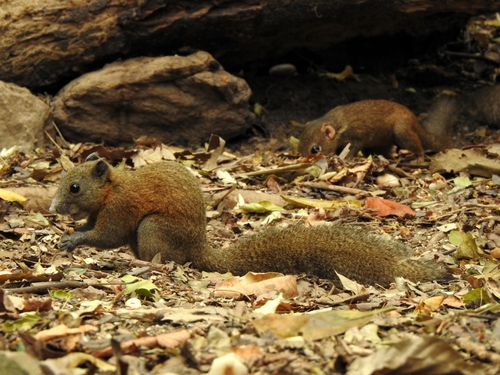
An arboreal squirrel of mainland South-east Asia, so undemanding in terms of habitat that it turns up just as readily in closed forest, plantations and urban gardens.
Medium-sized, with a greyish belly that gives the species its name, an olive-brown back and a long, bushy tail. Telling it from other Callosciurus species of the same region can be difficult without paying attention to details of the belly fur.
Builds globular nests of leaves and twigs in treetops. Leaves remains of gnawed fruit and seeds on the ground beneath its feeding trees, and gnaw marks on bark and nut shells.
Forests, plantations and gardens of the Malay Peninsula, Thailand, southern Myanmar, southern China (Yunnan) and possibly western Laos.
Omnivorous; feeds on fruit, seeds, shoots and insects.
Diurnal and arboreal, although it tolerates human-modified environments such as plantations and gardens well.
Widely distributed species that tolerates modified habitats, with no sign of significant decline.
No major threats have been identified at global scale.
See all species accounts for rodents · Full species index
Mammaling is a free app for logging the mammals you find. You record a sighting in a moment — even if it's just a track — your life list grows, and the record becomes available to scientific and conservation projects.
It runs on your phone with nothing to install. If you like, it adds to your home screen like any other app.
Open Mammaling