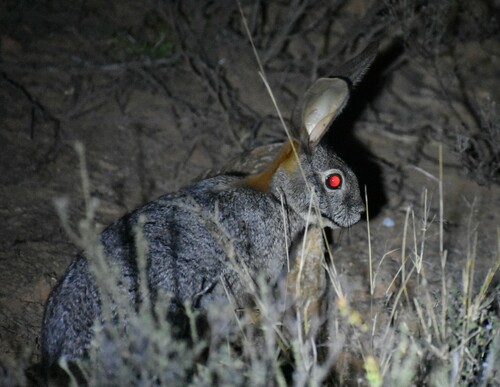
One of the most threatened mammals on the planet, restricted to a narrow strip of dense scrub along seasonal rivers of the South African Karoo, a habitat that has largely been lost through conversion to cropland. With fewer than 250 mature individuals estimated in total and an extremely low reproductive rate for a rabbit, its recovery depends almost entirely on protecting the riverine vegetation that remains.
Medium-sized rabbit with greyish-brown fur, a characteristic black stripe running from the corner of the mouth to the cheek, a woolly brown tail with a blackish tinge, and broad, club-shaped hind feet. It differs from the Scrub Hare and the Cape Hare in that black facial stripe and in a distribution strictly tied to the dense riverine vegetation of the Karoo.
Typical rabbit tracks, rarely seen given the scarcity of the species. It uses shallow burrows dug in soft alluvial soil under dense scrub, often reusing those of other species. Droppings are typical leporid pellets left scattered in the riverine scrub. It is able to leap over shrubs more than a metre high when fleeing.
Dense scrub along seasonal rivers and their floodplains in the central and southern Karoo of South Africa, a naturally fragmented habitat now greatly reduced by agriculture.
Herbivorous, feeding on leaves and shoots of riverine shrubs, with a diet that is poorly documented in detail.
Solitary and crepuscular to nocturnal, with an unusually low reproductive rate for a leporid, since it produces few young per litter and few litters a year.
One of the most threatened mammal species in Africa, with a total population estimated at barely a few hundred mature individuals and no subpopulation of more than a hundred. The historical conversion of the Karoo's riverine vegetation into cropland has been the main cause of its decline.
Continuing loss and fragmentation of riverine habitat to agriculture, overgrazing of the scrub by livestock, and a naturally low reproductive rate that hinders the population's recovery.
See all species accounts for rabbits and hares · Full species index
Mammaling is a free app for logging the mammals you find. You record a sighting in a moment — even if it's just a track — your life list grows, and the record becomes available to scientific and conservation projects.
It runs on your phone with nothing to install. If you like, it adds to your home screen like any other app.
Open Mammaling