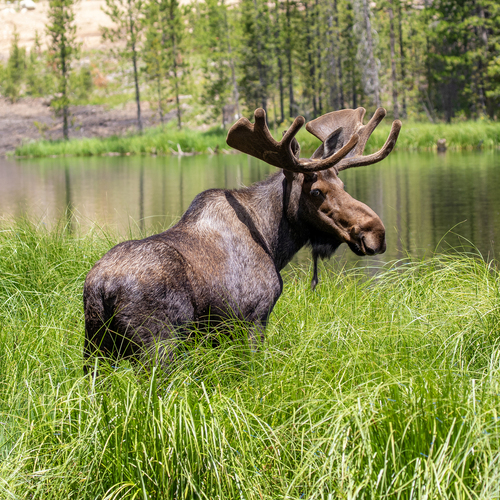
The largest living deer: a male from Alaska can top 2 m at the withers and 700 kg. Its antlers are the fastest-growing tissue known in any mammal, and a big male produces a new pair every summer that can weigh around 30 kg, only to drop it in winter and start again. Despite its size it swims with ease, crosses sea channels several kilometres wide and puts its head under water to pull up aquatic plants, which it seeks out for their sodium.
It occupies the boreal forests of the whole northern hemisphere, from Norway to Alaska and Newfoundland, with more than 2.2 million animals around 2010. Some populations are growing and others are collapsing. In northern Europe it supports one of the continent's most important hunts. In Poland it went from a few dozen after the Second World War to tens of thousands. By contrast, on the southern edge of its range in North America, ticks and the parasites carried by the White-tailed Deer have reduced some populations by half or more. In Newfoundland, where four animals were brought in 1904, there are now more than a hundred thousand.
The taxonomy is disputed. Some authors separate the American Moose (Alces americanus), which also lives in eastern Siberia, from the Eurasian Moose (Alces alces) on a difference in chromosome number (70 versus 68). DNA studies show that all present-day populations descend from Asia and that North America was colonised less than about 15,000 years ago, and most checklists keep a single species. This account treats it that way.
Enormous animal with very long legs, a hump at the withers and a short neck. The head is long and the muzzle thick and pendulous, and beneath the throat hangs the “bell”, a fold of haired skin present in both sexes whose shape varies with age. The coat is dark brown to almost black, with greyish or pale legs and a somewhat paler face. On males' faces the tone darkens from mid-August. Females have a white patch under the tail, around the vulva, which is used to sex them from a light aircraft. Calves are reddish-brown and, unlike those of nearly all deer, are not spotted. In late winter, animals heavily loaded with ticks lose hair and look greyish or whitish (“ghost moose”).
Size varies greatly between regions. The largest live in Alaska and eastern Siberia, with males of over 600 kg and records of over 770. The smallest, in the Amur and Manchuria, have males of about 260 kg. European animals fall in between: males weigh about 320-475 kg.
Only the male has antlers, which are usually palmate, like a shovel with points along the edge:
• In North America the palm usually divides into two lobes, and in Eurasia it forms a single one.
• In Europe antlers without a palm, branched like a deer's, are frequent, and in Manchuria typical.
• Average spread: about 105 cm in Europe and about 145 cm in Alaska, with records of over 2 m.
• Cycle: the male strips the velvet in September, casts the antlers between November and January (young males may keep them until spring) and begins growing new ones from April. They reach their peak at about 7-12 years.
What it is confused with:
• Red Deer and Wapiti. They have a pale rump patch, a lighter, redder body and a neck with a dark mane, and the antlers have no palm. They are also much lower-standing.
• Reindeer or Caribou. It has a pale neck and rump, and females also carry antlers.
• Horse, at a distance. The Moose's hump, bell and long, drooping head give it away.
Tracks: large, heart-shaped, somewhat asymmetrical, 11-18 cm long and 9.5-15 cm wide in the fore foot; the hind track is somewhat smaller (10.5-16.5 cm). In mud or soft snow the dewclaws register behind. The stride at a walk is about 1.5-2 m. In deep snow it drags its feet and leaves long, parallel furrows.
How to tell the track from those of other ungulates sharing its habitat:
• Wapiti. Its fore track measures 7.6-12.4 cm.
• White-tailed and Mule Deer. About 7.5 cm, with strides of 75-90 cm.
• Red Deer. About 8-9 cm in large males, clearly smaller than that of an adult Moose. There are no reliable published measurements of Moose calf tracks, so a medium-sized track in snow or mud should be assigned with caution.
• Reindeer, cattle and horses. There are no reliable published comparisons. As a general rule, a horse leaves a round, single-hoof track, and a cow two broader, more rounded hoofprints.
Droppings: in winter they are large pellets 2-3 cm long (up to about 4.4 cm) and 1.3-2 cm thick, rounded or somewhat square, fibrous and full of twig remains. With the tender vegetation of spring and summer they come out loose or in pats, which in Alaska have been mistaken for bear droppings. The pellets of large Wapiti overlap in size with those of the Moose; Wapiti pellets are usually oval, with a dimple at one end.
Browsing: like all deer, it lacks upper incisors, so twigs are left torn, not cleanly cut like those gnawed by hares and rodents. What gives the Moose away is the height: it browses up to 1.8-2.4 m. Males bend or trample saplings to reach the crown, and tooth marks may appear about 30 cm from the point of breakage. Accumulated snow lets smaller deer reach higher, so height alone is not definitive.
Bark stripping: it tears bark off from the bottom up with its lower incisors. The mark is frayed at the upper end and clean at the lower, and is at first yellowish. In Scandinavia it mainly affects Scots pine and less so Norway spruce; in North America, maples and aspens.
Other signs:
• Rubbing posts and shrubs wrecked by antlers, 0.4 to 2.4 m high.
• In the rut, pits scraped out by the male, which urinates in them and splashes his head, bell and antlers; they smell strong.
• Day beds in the snow.
Sounds: the female gives a long, plaintive moo; the male, short, low grunts. They are heard mostly in September and October.
Lives in the taiga and in the temperate mixed forests of the north, especially near wet or waterlogged areas such as lake and river margins, peat bogs and willow thickets, and in Alaska it also occupies shrubby willow tundra. It is favoured by fires, clear-cuts and roadsides, where the young scrub it feeds on regrows. Two limits mark where it can live: snow deeper than about 70 cm and a mean summer temperature above about 14 °C. It climbs to about 1,700 m in the Altai.
In Europe it lives in Fennoscandia, the Baltic states, Poland, Belarus and northern Ukraine. In Asia it occupies the whole of Russia as far as the Far East, northern Mongolia and north-eastern China, and in North America, Alaska, almost all of Canada and the northern USA, from New England and the Great Lakes to the Rocky Mountains, including Colorado and Utah. It was introduced to Newfoundland in 1904 and to Colorado, where 24 animals were released in 1978, although recent research argues that the species already lived there before. In Denmark, Moose were released at Lille Vildmose in 2016-2017.
Its range has changed greatly over time. At the start of the Holocene it lived in Great Britain, the Alps and the Pyrenees; in the Middle Ages it remained only in Fennoscandia and eastern Europe, and the Caucasus population disappeared in the early 19th century. From Poland it has partly recolonised Germany, the Czech Republic, Slovakia and northern Austria, always in very low numbers, and on the border between the Czech Republic, Austria and Germany sightings have plummeted since 2013. Stray animals reach as far as Croatia and Romania. In China, Mongolia and Kazakhstan its range is shrinking, while in the north-eastern USA, where it had disappeared from much of its range by about 1870, it has recovered since the 1980s.
It is a browser: it eats mainly leaves, shoots and twigs of trees and shrubs. It prefers willows, birches, aspens and alders, and in winter turns to conifers: balsam fir in Canada and Scots pine in Scandinavia. In summer, in Norway, deciduous woody vegetation made up around 71% of the males' diet, and willows alone more than half. The same studies show that it combines foods to balance protein, fat and carbohydrate: in Sweden, in winter, it mixes pine and bilberry to approach the nutritional value of willow, which it actively seeks.
In summer it also eats aquatic plants: on Isle Royale they made up between 13 and 27% of the summer diet. It seeks them for their sodium, which is scarce in land plants. For the same reason it visits natural salt licks, which supply about fifteen times more sodium per minute than aquatic plants, and licks the salt spread on roads.
An adult eats 10-30 kg of fresh vegetation a day; in winter, about 18-22 kg of twigs. It spends 9-13 hours a day eating in summer and 6-8 in winter, spread over 5 to 8 sessions.
It is active by day and night, with more movement at dawn and dusk. It is basically solitary: the stable unit is the mother with her calf, and males live apart for most of the year, although in open terrain, such as the Alaskan tundra, it forms loose groups.
Home ranges of sedentary animals measure 2 to 90 km². Many populations migrate between summer and winter areas normally 10-30 km apart, but as much as about 200 km in North America and 300-500 km in Siberia. Young animals disperse 180-250 km, and the known record is that of a Moose that went from South Dakota to Texas, 1,511 km. It runs at about 60 km/h.
The rut runs from mid-September to early October. In forest, each male accompanies and defends a single female at a time, while on open tundra males gather groups of females. A male loses between 9 and 18% of his weight in the rut and barely eats for about two weeks. Females are receptive for about a day, between 15 and 26 hours, and if they do not become pregnant they come into oestrus again after 24 days.
Gestation lasts about 230 days, and births are concentrated between mid-May and mid-June: in Denali, 95% fall within 16 days. Calves weigh 10-18 kg at birth, more in Alaska than in Europe. Twinning depends heavily on food; in North America rates of between 0 and 90% have been measured depending on the population, with averages of around 30-47% where food is plentiful, and in the tick-plague years in New Hampshire none were born. The mother strays little from the calf in the first week. The calf starts eating plants at two or three weeks, suckles for four or five months and stays with its mother until the next birth, when she drives it off. Females usually breed for the first time at 28 months, sometimes at 16, and where there is no hunting dominant males prevent young males from breeding until the age of five.
Its main predators are the Wolf and the Brown Bear, and calves also fall to the Black Bear and the Puma; in some parts of North America, predators cause up to 80% of newborn deaths. In the Far East it is also hunted by the Tiger. In winters of deep snow, the Wolves of Isle Royale kill about three times as many Moose per day.
The species is abundant overall, but its regional trends run in opposite directions. In Eurasia there were around 1.2 million Moose in about 2010, concentrated in Russia and Fennoscandia. Russia exceeded 800,000 in 1990, and in its European part the population fell to less than half between 1990 and 2002 through excessive hunting that track counts in the snow do not detect well. In Scandinavia hunting is tightly regulated. Sweden, which came close to losing the species in the 18th and 19th centuries, shot some 50,000 Moose in 2023-2024, around a fifth of the pre-season population, and since 2012 has managed it in some 130 areas with three-year plans. Finland hunts about 37,000 a year and Norway about 27,500, and all three populations are now considered to be declining. In Poland it is not hunted, and from there the species is spreading into central Europe. Further east, Mongolia's national red list considers it threatened after it lost more than half its numbers, and in China it has been shrinking since the 1970s along with its forest.
In North America there are between 0.9 and 1.4 million Moose, stable in most territories but with sharp declines at the southern edge. In north-eastern Minnesota they fell by 60% from the mid-2000s, although they have been stable for years at around 4,000, and in the north-west of the state fewer than a hundred remain. In New Hampshire and Vermont the population has halved or worse since the turn of the century. Minnesota now allows only tribal hunting, and Nova Scotia suspended hunting on its mainland.
In central Europe, where habitat does exist, the priority is to reduce roadkill and illegal hunting through agreements between countries.
On the southern edge of North America, the main threat is parasites, worsened by climate. The winter tick killed 70% of the marked calves in New Hampshire and Maine between 2014 and 2016, with an average of about 47,000 ticks per animal. The meningeal worm, which is carried by the White-tailed Deer, was implicated in almost a quarter of adult Moose deaths in north-eastern Minnesota, and the giant liver fluke has also been linked to high mortality in that state.
Heat is the other face of the same problem. The Moose begins to suffer above about -5 °C in winter and about 14 °C in summer, and in captivity it shows stress from 17 °C, so warmer winters and summers force it to burn energy or stop eating.
Collisions with cars and trains kill thousands of animals. In Norway, trains killed about 13,000 Moose between 2000 and 2008, and in the south of the Czech Republic and in Austria roadkill is the main known cause of human-caused death. Excessive hunting and poaching explain the declines in European Russia, Mongolia and China. In China there is also the loss of forest, whose cover in its range fell from more than 70% to 35%, and forest tracks make access easier for hunters and predators.
Chronic wasting disease, the prion disease of cervids, is closely monitored. Since 2016 a few cases have been detected in old Moose in Norway and one in Finland, of an atypical form that could be sporadic, and so far it has not been shown to threaten populations.
See all species accounts for even-toed ungulates · Full species index
Mammaling is a free app for logging the mammals you find. You record a sighting in a moment — even if it's just a track — your life list grows, and the record becomes available to scientific and conservation projects.
It runs on your phone with nothing to install. If you like, it adds to your home screen like any other app.
Open Mammaling